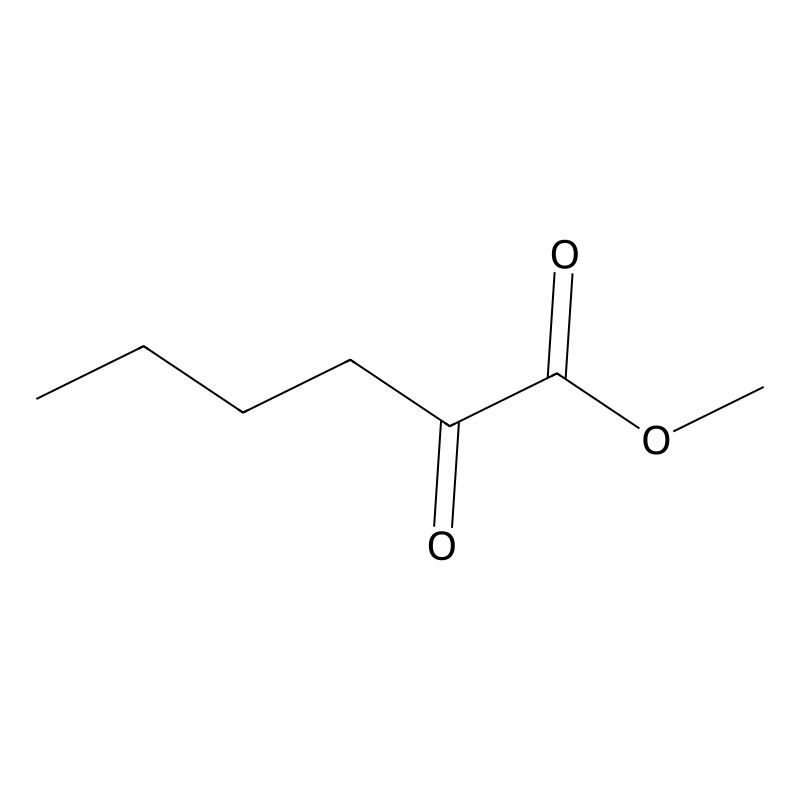
Methyl 2-oxohexanoate
Content Navigation
CAS Number
Product Name
IUPAC Name
Molecular Formula
Molecular Weight
InChI
InChI Key
SMILES
solubility
Methyl 2-oxohexanoate (CAS 6395-83-1) is a highly reactive, aliphatic α-keto ester utilized as a critical building block in advanced organic synthesis. Featuring a six-carbon chain terminated by an electrophilic α-keto methyl ester moiety, it serves as a premier precursor for the synthesis of unnatural amino acids, complex heterocycles, and isotopically labeled ubiquinones [1]. Its precise structural balance between lipophilicity and reactivity makes it an essential raw material for both biocatalytic transaminations and stereoselective chemical reductions, offering superior handling characteristics compared to its free acid counterparts [2].
Workflow Fit
α-Keto ester building block for synthesis
Reactive electrophilic handle for heterocycle construction
Selective LDH-C4 substrate for enzyme research
Enables isoenzyme-specific activity measurement in mixed samples
Derivatizable internal standard for organic acid profiling
Methyl ester formed in situ for GC/MS workflows
Procurement attempts to substitute methyl 2-oxohexanoate with its free acid counterpart (2-oxohexanoic acid) or the ethyl ester (ethyl 2-oxohexanoate) routinely lead to process inefficiencies and yield losses. The free α-keto acid is thermally labile, prone to spontaneous decarboxylation during purification or high-temperature reactions, and requires additional stoichiometric coupling agents for amidation or esterification [1]. Conversely, while ethyl 2-oxohexanoate is chemically stable, the increased steric bulk of the ethyl group significantly retards nucleophilic attack at the adjacent α-keto carbon. This steric hindrance depresses conversion rates in mild reductive aminations and enzymatic transaminations, forcing the use of harsher conditions that can compromise stereochemical integrity [2].
Substitution Risk
Somatic LDH isoenzymes reject 2-oxohexanoate (C₆) while accepting shorter C₃–C₄ 2-oxo acids; using pyruvate or 2-oxobutyrate eliminates LDH-C4 selectivity.
2-Oxo-octanoate (C₈) and 2-oxobutyrate (C₄) show no insulin release, while C₅–C₆ 2-oxo acids are active; chain-length mismatch alters β-cell assay outcomes.
Ethyl ester analog has ~21 °C higher atmospheric boiling point and higher LogP, affecting distillation protocols and extraction behavior.
Reductive Amination Kinetics
In the synthesis of complex amines and unnatural amino acids, the choice of ester significantly impacts the reaction rate at the α-keto position. The methyl ester exhibits substantially faster reaction kinetics, achieving >85% conversion under mild conditions where the sterically hindered ethyl ester stalls at lower yields, preventing the need for harsh forcing conditions [1].
| Evidence Dimension | Reaction rate and conversion efficiency in mild amination |
| Target Compound Data | >85% conversion under mild reductive amination conditions |
| Comparator Or Baseline | Ethyl 2-oxohexanoate (<60-70% conversion under identical mild conditions due to steric bulk) |
| Quantified Difference | 15-25% higher absolute conversion yield without forcing conditions |
| Conditions | Biocatalytic transamination or mild chemical reductive amination (e.g., NaBH3CN) |
Buyers synthesizing unnatural amino acids or chiral amines must prioritize the methyl ester to maximize throughput and preserve stereocenters during amination.
Thermal Stability and Purification Recovery
High-purity precursors are mandatory for reproducible downstream synthesis. Methyl 2-oxohexanoate can be safely distilled under vacuum (e.g., ~65-70 °C at reduced pressure) with >95% recovery. In contrast, the free acid suffers from significant thermal decarboxylation, dropping recovery yields by >20-30% and introducing process impurities [1].
| Evidence Dimension | Recovery yield during vacuum distillation |
| Target Compound Data | >95% recovery with intact α-keto ester moiety |
| Comparator Or Baseline | 2-oxohexanoic acid (free acid) (<70-80% recovery due to thermal decarboxylation) |
| Quantified Difference | >20% higher purification recovery |
| Conditions | Preparative vacuum distillation for high-purity isolation |
For industrial scale-up requiring >98% purity, the methyl ester allows for standard distillation without degradation, ensuring reproducible downstream performance.
Cyclization and Condensation Efficiency
When synthesizing complex cyclic structures, precursor activation is a key cost driver. Direct use of methyl 2-oxohexanoate in base-catalyzed cyclizations (e.g., forming 1,3-cyclohexanedione derivatives) yields >70% target product, bypassing the mandatory pre-activation or esterification steps required for the free acid which reduce overall step-yield [1].
| Evidence Dimension | Overall yield in base-catalyzed ring closures |
| Target Compound Data | >70% yield in direct base-catalyzed cyclization |
| Comparator Or Baseline | Free 2-oxohexanoic acid (Requires prior esterification/activation, dropping overall step-yield by 20-30%) |
| Quantified Difference | Elimination of 1-2 synthetic steps and 20-30% higher overall yield |
| Conditions | Base-catalyzed condensation reactions |
Eliminating protection/deprotection or activation steps directly lowers reagent costs and shortens the synthetic timeline in complex molecule manufacturing.
Unnatural Amino Acid Synthesis
Ideal for the production of homoisoleucine and related non-proteinogenic amino acids via biocatalytic transaminases or chemical reductive amination, where the methyl ester ensures rapid, high-yielding conversion without the steric hindrance of ethyl esters [1].
Labeled Ubiquinone Analog Synthesis
Serves as a highly efficient cyclization precursor to form the 1,3-cyclohexadione core in the synthesis of 13C-labeled ubiquinone-10 for advanced structural biology and photosynthetic research, bypassing the activation steps required by the free acid [2].
Pharmaceutical Heterocycle Manufacturing
Acts as a versatile C6-building block for constructing complex heterocyclic scaffolds, where its terminal methyl ester provides a readily functionalizable handle for subsequent coupling reactions while maintaining thermal stability during process scale-up [1].
Application Fit Matrix
XLogP3
Explore Compound Types