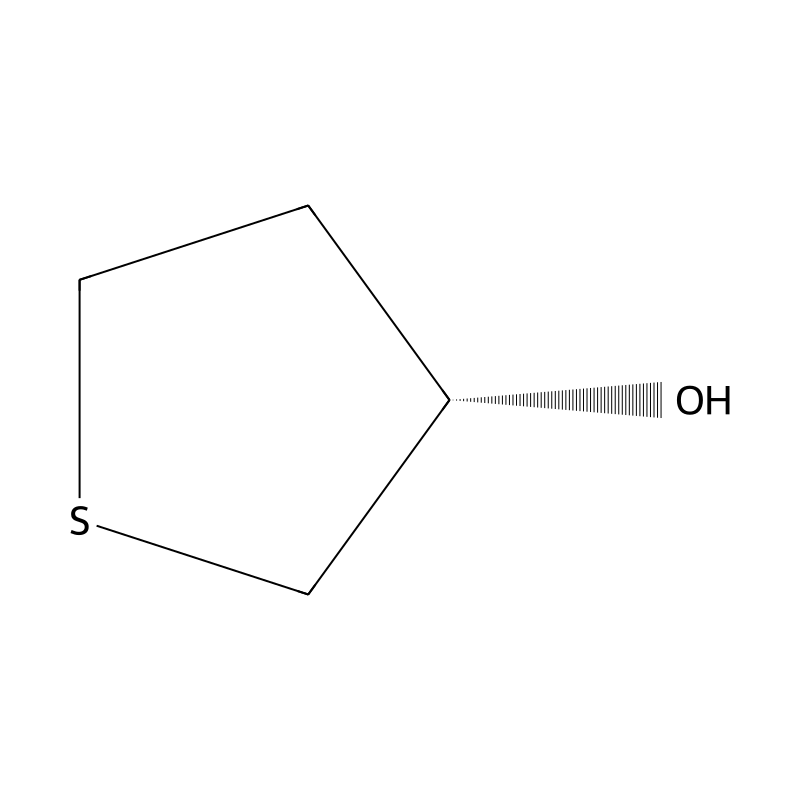
(3S)-thiolan-3-ol
Content Navigation
CAS Number
Product Name
IUPAC Name
Molecular Formula
Molecular Weight
InChI
InChI Key
SMILES
solubility
Meteorology
Field: Atmospheric Science
Summary: “(3S)-thiolan-3-ol” could be used in meteorological studies, particularly in the development of models for weather prediction or climate analysis.
Methods: Integration with remote sensing data, atmospheric sampling.
Results: Enhanced accuracy in weather forecasting and climate modeling .
Information Technology
Field: Software Development
Methods: Precision engineering, quality control.
Results: Production of more efficient and reliable IT hardware .
Manufacturing
Field: Industrial Engineering
Summary: This compound might be involved in the creation of specialized materials or chemicals used in manufacturing processes.
Methods: Process optimization, control of reaction conditions.
Results: Improved manufacturing efficiency and product quality .
Land Use and Ecology
Field: Environmental Planning
Summary: Compounds like “(3S)-thiolan-3-ol” may be used in studies related to land use, helping to understand and manage ecological impacts.
Methods: GIS mapping, ecological surveys.
Results: Better-informed land use planning and management strategies .
Glaciology
Field: Earth Sciences
Summary: Such compounds could be used in the analysis of ice cores or glacial chemistry, contributing to our understanding of climate history.
Methods: Ice core drilling, chemical analysis.
Results: Insights into past climate conditions and environmental changes .
(3S)-thiolan-3-ol, also known as 3-thiolane-3-ol, is a sulfur-containing organic compound characterized by a thiolane ring, which is a saturated six-membered ring that includes a sulfur atom. The specific stereochemistry of the compound, denoted by (3S), indicates that it possesses a chiral center at the third position of the thiolane ring. This stereochemistry can significantly influence its chemical behavior and biological activity. The presence of the hydroxyl group (-OH) in conjunction with the thiolane structure contributes to its potential reactivity and interaction with biological systems.
The chemical reactivity of (3S)-thiolan-3-ol can be explored through various reactions, including:
- Nucleophilic Substitution: The thiol group can act as a nucleophile, participating in substitution reactions with electrophiles.
- Oxidation: The hydroxyl group can be oxidized to form carbonyl compounds, enhancing its reactivity in organic synthesis.
- Condensation Reactions: The compound can undergo condensation reactions with aldehydes or ketones, leading to the formation of more complex molecules.
These reactions are essential for understanding how (3S)-thiolan-3-ol might interact in biological environments and its potential applications in medicinal chemistry.
Compounds similar to (3S)-thiolan-3-ol often display various biological activities, including antimicrobial, antiviral, and anticancer properties. The biological effects may arise from its ability to interact with cellular targets or influence metabolic pathways. In silico predictions using computational tools like PASS (Prediction of Activity Spectra for Substances) suggest that (3S)-thiolan-3-ol may exhibit significant pharmacological effects based on its molecular structure.
Several synthetic routes can be employed to produce (3S)-thiolan-3-ol:
- Ring Closure Reactions: Starting from appropriate precursors, thiolane rings can be formed through cyclization reactions involving sulfur sources.
- Functional Group Modifications: Existing thiolane derivatives can be modified through hydroxylation processes to introduce the -OH group.
- Chiral Resolution Techniques: Enantiomerically pure forms may be obtained through resolution methods involving chiral catalysts or reagents.
Each synthesis method must be optimized for yield and purity while considering environmental impacts.
(3S)-thiolan-3-ol has potential applications in various fields, including:
- Pharmaceuticals: As a building block in drug development due to its unique structural properties and biological activities.
- Agricultural Chemicals: Its antimicrobial properties may make it suitable for use in agrochemicals.
- Flavoring Agents: The compound's organoleptic properties could allow it to be utilized in food flavoring.
Understanding how (3S)-thiolan-3-ol interacts with biological targets is crucial for assessing its potential therapeutic applications. Interaction studies may involve:
- Binding Affinity Assessments: Evaluating how well the compound binds to specific receptors or enzymes.
- Mechanistic Studies: Investigating the pathways through which the compound exerts its biological effects.
- Toxicological Evaluations: Assessing any adverse effects associated with its use.
Several compounds share structural similarities with (3S)-thiolan-3-ol, which helps contextualize its uniqueness:
| Compound Name | Structure Features | Unique Aspects |
|---|---|---|
| 2-Amino-thiolane derivative | Contains an amino group and thiolane ring | Potentially different biological activity |
| 4-Methylphenyl-thiol derivative | Similar aromatic substitution | Variation in functional groups |
| Hydroxy-thiolane derivatives | Hydroxylated thiolanes | Varying degrees of oxidation states |
The uniqueness of (3S)-thiolan-3-ol lies in its specific stereochemistry and combination of functional groups that may confer distinct biological properties compared to these similar compounds. Its potential as a versatile compound in medicinal chemistry and other applications highlights the importance of further research into its properties and interactions.
XLogP3
Explore Compound Types