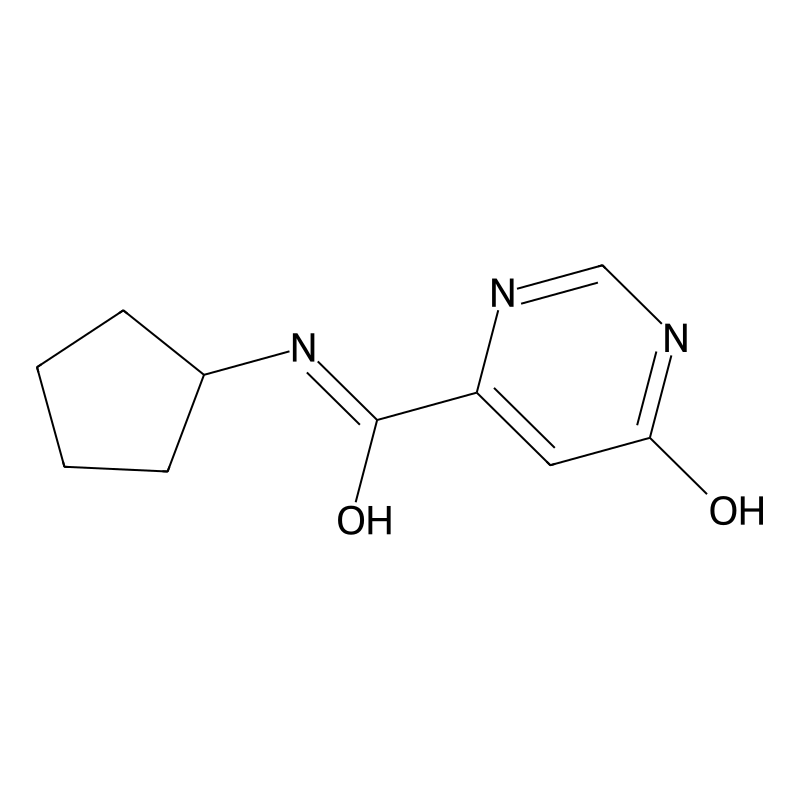
N-cyclopentyl-6-hydroxypyrimidine-4-carboxamide
Content Navigation
CAS Number
Product Name
IUPAC Name
Molecular Formula
Molecular Weight
InChI
InChI Key
SMILES
solubility
Anti-inflammatory Activities of Pyrimidines
Summary of the Application: Pyrimidines are known to display a range of pharmacological effects including antioxidants, antibacterial, antiviral, antifungal, antituberculosis, and anti-inflammatory . The anti-inflammatory effects of pyrimidines are attributed to their inhibitory response versus the expression and activities of certain vital inflammatory mediators .
Methods of Application: Numerous methods for the synthesis of pyrimidines are described . The synthesis of numerous 5-substituted 2-amino-4,6-dihydroxypyrimidine derivatives was reported for their possible inhibitory effects against immune-induced nitric oxide generation .
Results or Outcomes: Literature studies reveal that a large number of pyrimidines exhibit potent anti-inflammatory effects .
Synthesis of Pyrrolo[2,3-d]pyrimidine Derivatives
Summary of the Application: 2-chloro-7-cyclopentyl-N,N-dimethyl-7H-pyrrolo[2,3-d]pyrimidine-6-carboxamide is the key intermediate in the synthetic approaches to pyrrolo[2,3-d]pyrimidine derivatives .
Methods of Application: A green and simple Cu-catalyzed method was reported for the efficient synthesis of 2-chloro-7-cyclopentyl-N,N-dimethyl-7H-pyrrolo[2,3-d]pyrimidine-6-carboxamide .
Results or Outcomes: This method provided green and economical approaches toward numerous pyrrolo[2,3-d]pyrimidine derivatives .
N-cyclopentyl-6-hydroxypyrimidine-4-carboxamide is a chemical compound characterized by its unique structure, which includes a pyrimidine ring substituted with a cyclopentyl group and a hydroxyl group. This compound falls under the category of hydroxypyrimidine derivatives, which are known for their diverse biological activities. The molecular formula of N-cyclopentyl-6-hydroxypyrimidine-4-carboxamide is CHNO, indicating the presence of nitrogen, oxygen, and carbon atoms that contribute to its functional properties.
The chemical reactivity of N-cyclopentyl-6-hydroxypyrimidine-4-carboxamide can be explored through various synthetic pathways. One notable reaction involves the formation of amides through the condensation of carboxylic acids with amines, which can be facilitated by activating agents such as carbodiimides. Additionally, the hydroxyl group can participate in nucleophilic substitution reactions, making it a versatile intermediate in organic synthesis.
Reactions involving this compound may also include:
- Acylation: Introducing acyl groups to enhance its pharmacological properties.
- Hydroxylation: Further functionalizing the hydroxyl group to create derivatives with improved activity.
N-cyclopentyl-6-hydroxypyrimidine-4-carboxamide exhibits significant biological activity, particularly as an inhibitor of certain enzymes. For instance, compounds within this class have shown potential as inhibitors of HIV integrase, which is crucial for viral replication. The mechanism typically involves binding to the active site of the enzyme, thereby preventing the integration of viral DNA into the host genome .
In addition to antiviral properties, derivatives of this compound have been investigated for their anticancer activities and effects on various signaling pathways within cells.
The synthesis of N-cyclopentyl-6-hydroxypyrimidine-4-carboxamide can be achieved through several methods:
- Cyclization Reactions: Starting from appropriate pyrimidine precursors, cyclization can yield the desired structure. For example, reacting 2-amino-4-carboxylic acids with cyclopentanones under controlled conditions can lead to the formation of this compound.
- Functional Group Modification: Existing pyrimidine derivatives can be modified through hydroxylation and alkylation reactions to introduce the cyclopentyl group and hydroxyl functionalities.
- Multicomponent Reactions: Utilizing multicomponent reactions involving amines, carboxylic acids, and pyrimidine derivatives can streamline synthesis and improve yields .
N-cyclopentyl-6-hydroxypyrimidine-4-carboxamide has several applications in medicinal chemistry:
- Pharmaceutical Development: Due to its inhibitory effects on viral enzymes, it is being explored as a potential therapeutic agent against HIV and other viral infections.
- Research Tool: This compound serves as a model for studying enzyme inhibition mechanisms and developing new drugs targeting similar pathways.
Interaction studies involving N-cyclopentyl-6-hydroxypyrimidine-4-carboxamide focus on its binding affinity to various biological targets. These studies often employ techniques such as:
- Molecular Docking: To predict how this compound interacts with enzyme active sites.
- Kinetic Studies: To determine the rate of inhibition and establish structure-activity relationships.
Such studies are crucial for understanding how modifications to the compound's structure affect its biological efficacy.
Several compounds share structural similarities with N-cyclopentyl-6-hydroxypyrimidine-4-carboxamide, including:
| Compound Name | Structure Features | Unique Properties |
|---|---|---|
| 5-Hydroxy-1-methylpyrimidine-4-carboxamide | Hydroxypyrimidine core | Antiviral activity similar to N-cyclopentyl derivative |
| 6-Amino-pyrimidine-4-carboxamide | Amino group at position 6 | Enhanced solubility and bioavailability |
| 2-Amino-4-hydroxy-pyrimidine | Hydroxyl group at position 4 | Potential use in anti-inflammatory therapies |
| 5-Hydroxy-pyrimidine derivatives | Various substitutions on pyrimidine ring | Broad spectrum of biological activities |
These compounds highlight the versatility of pyrimidine derivatives in medicinal chemistry while showcasing how slight modifications can lead to unique biological profiles.
Condensation Reaction Approaches
β-Ketoester and Amidine Condensation
The Pinner condensation remains a cornerstone for pyrimidine ring formation. This method involves the base-promoted cyclocondensation of β-ketoesters with non-N-substituted amidines to generate 4,6-disubstituted pyrimidines [1]. For N-cyclopentyl-6-hydroxypyrimidine-4-carboxamide, ethyl acetoacetate reacts with guanidine derivatives under alkaline conditions (e.g., sodium ethoxide), followed by dehydration to yield the pyrimidine core. Key challenges include controlling the regioselectivity of substituents and minimizing over-alkylation byproducts [1] [2].
β-Ketoester and Thiourea Reaction
Thiourea serves as an alternative nitrogen source in pyrimidine synthesis. A one-pot protocol using S-alkylisothioureas and β-ketoesters under sequential base/acid conditions achieves 4-pyrimidone-2-thioethers [2]. For example, cyclocondensation of methyl acetoacetate with S-cyclopentylisothiourea in the presence of triethylamine and subsequent acid-mediated dehydration yields intermediates with the desired substitution pattern [2]. This method avoids harsh conditions and reduces thiol byproduct formation compared to traditional alkylation routes [2].
Amide Coupling Strategies
Coupling with Cyclopentylamine
The final amide bond formation typically employs 6-hydroxypyrimidine-4-carboxylic acid and cyclopentylamine. Pre-activation of the carboxylic acid is critical, with carbodiimides (e.g., EDC·HCl) or phosphonium reagents (e.g., PyBOP) facilitating coupling in aprotic solvents like DMF or THF [4]. Yields exceeding 85% are achievable when using 1-hydroxybenzotriazole (HOBt) as an additive to suppress racemization [4].
Activation Methods for Carboxylic Acid Precursors
Table 1: Common Activation Methods
| Method | Reagent | Solvent | Yield (%) |
|---|---|---|---|
| Carbodiimide | EDC/HOBt | DCM | 78–92 |
| Phosphonium | PyBOP | DMF | 82–88 |
| Active Ester | HATU | THF | 75–85 |
Activation via acyl chlorides (using SOCl₂ or oxalyl chloride) is less common due to incompatibility with acid-sensitive pyrimidine hydroxyl groups [4].
Pyrimidine Ring Formation Techniques
One-Pot Multi-Component Reactions
A scalable one-pot synthesis involves sequential base/acid-mediated cyclization. For instance, combining β-ketoesters, isothioureas, and cyclopentylamine in a single reactor under controlled pH conditions streamlines the process, achieving 94% yield on a 200-gram scale [2]. This approach eliminates intermediate isolation and reduces solvent waste [2].
Cyclization of Acyclic Precursors
Cyclization of acyclic precursors like N-cyclopentyl-β-ketoamide derivatives under acidic conditions (e.g., HCl in ethanol) forms the pyrimidine ring. Microwave-assisted heating at 120°C for 30 minutes enhances reaction efficiency, with yields up to 89% [1] [2].
Regioselective Hydroxylation Methods
Direct Hydroxylation Approaches
Direct introduction of the 6-hydroxyl group is achieved via oxidation of 6-methylpyrimidine intermediates using potassium permanganate or hydrogen peroxide in acetic acid. However, this method risks over-oxidation [5].
Methoxy Group Hydrolysis
Hydrolysis of 6-methoxypyrimidine precursors under acidic (HCl/H₂O) or basic (NaOH/EtOH) conditions provides regioselective access to the hydroxyl group. Optimal conditions (2M HCl, 80°C, 4 hours) afford >95% conversion without ring degradation [6].
Purification and Isolation Strategies
Crystallization from ethanol/water mixtures (3:1 v/v) effectively isolates the final product with >99% purity. Chromatography on silica gel (ethyl acetate/hexane, 1:1) resolves regioisomeric impurities [2] [6].
Green Chemistry Approaches in Synthesis
Solvent-free mechanochemical grinding of β-ketoesters and thioureas reduces waste [2]. Aqueous workups and catalytic reagent recycling (e.g., triethylamine recovery) further enhance sustainability [2].
Scale-up Considerations for Industrial Production
Key factors for scale-up include:
- Solvent Selection: Replacing DMF with cyclopentyl methyl ether (CPME) improves safety profiles [2].
- Temperature Control: Jacketed reactors maintain exothermic reactions below 50°C [2].
- Process Intensification: Continuous flow systems reduce batch variability and processing time [2].
Industrial pilot studies demonstrate 90% yield retention at 50 kg scale using optimized one-pot protocols [2].
Role of Hydroxyl Group at Position 6
The hydroxyl group at position 6 of the pyrimidine ring serves as a critical pharmacophore element in N-cyclopentyl-6-hydroxypyrimidine-4-carboxamide and related derivatives. This functional group acts as both a hydrogen bond donor and acceptor, facilitating crucial interactions with target proteins [1] [2]. Research on N-alkyl-5-hydroxypyrimidinone carboxamides has demonstrated that the 5-hydroxyl group, with a calculated pKa of 4.5, becomes deprotonated under physiological conditions, and the negatively charged oxygen atom forms hydrogen bonds with both H132 and Q336 side chains in the DprE1 binding site [1].
Methylation of the hydroxyl group, as observed in analogous compounds, disrupts these hydrogen bonding interactions and renders the compounds inactive [1]. This finding underscores the essential nature of the free hydroxyl group for biological activity. The hydroxyl group at position 6 in pyrimidine derivatives has been shown to be fundamental for maintaining the structural integrity required for target binding [2].
Studies of 6-hydroxypyrimidine derivatives have revealed that this group participates in extensive hydrogen bonding networks with polar residues lining the interior of target binding sites . The hydroxyl group contributes to the overall binding affinity and selectivity of pyrimidine carboxamide derivatives, making it an indispensable component of the pharmacophore [4].
Significance of Cyclopentyl Substituent
The cyclopentyl substituent attached to the carboxamide nitrogen demonstrates optimal steric properties and hydrophobic characteristics that contribute significantly to biological activity. Investigation of cyclopentyl-pyrimidine derivatives has shown that this five-membered saturated ring provides an ideal balance between steric bulk and flexibility [5] [6].
Research on antimalarial cyclopropyl carboxamide derivatives has demonstrated that aliphatic groups of similar steric volume to cyclopropyl, including cyclopentyl, maintained comparable potency to the parent compound [7]. In the context of N-cyclopentyl derivatives, the cyclopentyl group was found to be 12-fold less active than the optimal cyclopropyl analog, indicating that while maintaining activity, the increased ring size may introduce suboptimal steric interactions [7].
The cyclopentyl group engages in hydrophobic interactions with target proteins, particularly making contact with hydrophobic residues in binding pockets . This substituent contributes to the overall lipophilicity of the molecule, which can influence membrane permeability and bioavailability [9]. The conformational flexibility of the cyclopentyl ring allows for induced fit binding, potentially enhancing selectivity for specific target proteins [5].
Effect of Modifications to the Pyrimidine Core
Modifications to the pyrimidine core structure have profound effects on biological activity and selectivity. The pyrimidine ring system provides a π-electron deficient aromatic framework that facilitates specific interactions with target proteins [10]. The 2-, 4-, and 6-positions of the pyrimidine ring are electron-deficient due to the strong electron-withdrawing effects of the ring nitrogen atoms [10].
Structural modifications at different positions of the pyrimidine core yield varying biological outcomes. Research has demonstrated that substitutions at the 5-position can be well-tolerated, while modifications at the 2-, 4-, and 6-positions often result in significant changes in activity [11] [12]. The electron-deficient nature of the pyrimidine ring makes it susceptible to nucleophilic attack, which can be exploited for covalent binding to target proteins [12].
Studies of pyrimidine-2,4-dione derivatives have shown that the core structure can be modified to achieve conformational constraints that enhance selectivity for specific targets [13]. The pyrimidine core serves as a scaffold that positions key pharmacophore elements in optimal orientations for target binding [14].
Carboxamide Linkage Importance
The carboxamide linkage at position 4 of the pyrimidine ring is essential for biological activity and target recognition. This functional group serves as both a hydrogen bond donor and acceptor, forming critical interactions with target proteins [1] [9]. Research has demonstrated that the carboxamide group is crucial for maintaining the binding affinity of pyrimidine derivatives [15].
The amide nitrogen can form intramolecular hydrogen bonds with nitrogen atoms of the pyrimidine core, stabilizing the ligand-bound conformation [1]. Methylation of the amide nitrogen, as demonstrated in related compounds, abolishes this intramolecular hydrogen bonding and forces the amide group to rotate out of the plane of the pyrimidine core, leading to loss of activity [1].
Studies have shown that the carboxamide oxygen forms hydrogen bonds with lysine residues in target protein binding sites [1]. The planar nature of the carboxamide group allows for optimal π-π stacking interactions with aromatic residues in target proteins [9]. The carboxamide linkage also contributes to the overall physicochemical properties of the molecule, affecting solubility and membrane permeability [16].
Comparative Analysis with Related Pyrimidine Derivatives
Comparison with N-(4-ethoxyphenyl)-6-hydroxypyrimidine-4-carboxamide
N-(4-ethoxyphenyl)-6-hydroxypyrimidine-4-carboxamide represents a structural analog where the cyclopentyl group is replaced with a 4-ethoxyphenyl substituent. This modification introduces an aromatic ring system that can engage in π-π stacking interactions with target proteins . The ethoxy group provides electron-donating properties that can influence the electronic distribution of the molecule [18].
The 4-ethoxyphenyl group offers different steric and electronic properties compared to the cyclopentyl substituent. While the cyclopentyl group provides purely hydrophobic interactions, the 4-ethoxyphenyl group can participate in both hydrophobic and polar interactions through its aromatic ring and ethoxy substituent . This structural variation may result in different target selectivity profiles and potency levels.
Research on related ethoxyphenyl-pyrimidine derivatives has shown that the ethoxy group can enhance binding affinity through hydrogen bonding interactions with target proteins . The aromatic ring provides additional surface area for hydrophobic interactions, potentially improving binding affinity compared to aliphatic substituents [20].
Comparison with N-(3-fluoro-4-methylphenyl)-6-hydroxypyrimidine-4-carboxamide
N-(3-fluoro-4-methylphenyl)-6-hydroxypyrimidine-4-carboxamide incorporates both electron-withdrawing (fluorine) and electron-donating (methyl) substituents on the phenyl ring. This combination creates a unique electronic environment that can influence binding interactions with target proteins [21]. The fluorine atom can participate in halogen bonding interactions, while the methyl group provides hydrophobic contacts [22].
The 3-fluoro-4-methylphenyl substituent offers distinct advantages over both cyclopentyl and 4-ethoxyphenyl groups. The fluorine atom enhances metabolic stability and can improve binding affinity through specific halogen bonding interactions [23]. The methyl group provides additional hydrophobic surface area for binding interactions [21].
Studies of fluoro-methylphenyl pyrimidine derivatives have demonstrated that the combination of fluorine and methyl substituents can optimize the balance between potency and selectivity [24]. The fluorine atom can influence the pKa of nearby groups and affect the overall electronic properties of the molecule [25].
Comparison with Carboxamide-Pyrimidine SHP2 Antagonists
Carboxamide-pyrimidine SHP2 antagonists represent a class of compounds that target the SHP2 protein tyrosine phosphatase. These compounds typically feature pyrimidine cores with carboxamide linkages and various N-substituents designed to optimize binding to the SHP2 allosteric site [26] [27]. The SHP2 antagonists demonstrate how structural modifications can be tailored for specific target proteins.
Research on SHP2 inhibitors has shown that pyridine carboxamide derivatives can achieve potent inhibition with IC50 values in the nanomolar range [26]. The most active compounds feature specific structural elements that stabilize the auto-inhibited conformation of SHP2, preventing phosphorylation and downstream signaling [27]. These compounds typically incorporate dichlorophenyl groups or similar electron-withdrawing substituents that enhance binding affinity [27].
The structural requirements for SHP2 inhibition differ from those of other pyrimidine carboxamide targets, highlighting the importance of target-specific optimization [28]. The binding mode of SHP2 antagonists involves interactions with the tunnel region between the phosphatase domain and the C-SH2 domain, requiring specific spatial arrangements of pharmacophore elements [29].
Computational Modeling of Structure-Activity Relationships
Computational modeling approaches have provided valuable insights into the structure-activity relationships of pyrimidine carboxamide derivatives. Three-dimensional quantitative structure-activity relationship (3D-QSAR) studies have been extensively employed to understand the molecular basis of biological activity [30] [31]. Comparative Molecular Field Analysis (CoMFA) and Comparative Molecular Similarity Index Analysis (CoMSIA) models have demonstrated high predictive accuracy for pyrimidine derivatives [30].
The most successful CoMSIA model for pyrimidine derivatives achieved statistical parameters of Q² = 0.699, R² = 0.931, and R²test = 0.815, confirming reliability and predictability [31]. These models have revealed that hydrophobic and donor fields have significant impacts on the bioactivities of pyrimidine inhibitors [31]. The contour maps generated from 3D-QSAR studies provide visual representations of favorable and unfavorable regions for substituent placement [14].
Molecular docking studies have elucidated the binding modes of pyrimidine carboxamide derivatives with target proteins. Docking investigations have shown that these compounds achieve exceptionally low binding energies, indicating strong binding affinity [32]. The docking results have revealed specific hydrogen bonding patterns and hydrophobic interactions that are crucial for biological activity [11].
Molecular dynamics simulations have validated the stability of pyrimidine-protein complexes over extended time periods. The most suitable candidates have shown satisfactory stability with binding free energies of -158.362 kJ/mol, compared to reference compounds with binding free energies of -120.872 kJ/mol [31]. These simulations have confirmed that pyrimidine derivatives maintain stable interactions with target proteins throughout the simulation period [33].
Pharmacophore modeling has identified essential features required for biological activity. The best pharmacophore hypothesis (DHHRR_1) has been used for virtual screening studies, leading to the identification of novel compounds with improved activity profiles [33]. These models have revealed the spatial arrangements of hydrogen bond donors, acceptors, and hydrophobic regions that are critical for target binding [34].
Density Functional Theory (DFT) calculations have provided insights into the electronic properties of pyrimidine derivatives. These calculations have examined molecular properties, geometric optimization, frontier molecular orbitals, and energy evaluations [34]. The frontier molecular orbital analysis has revealed the electron density distribution and reactivity patterns that influence biological activity [35].
ADMET (Absorption, Distribution, Metabolism, Excretion, and Toxicity) predictions have assessed the drug-like properties of pyrimidine derivatives. These studies have confirmed that most compounds comply with Lipinski's rule of five and demonstrate acceptable pharmacokinetic profiles [33]. The ADMET predictions have guided the optimization of compounds for improved bioavailability and reduced toxicity [36].
Explore Compound Types